Archive for April, 2008

Monty Hall does UX

A colleague (Mike Betz, Content Manager) recently sent this email:

“You’re on “Let’s Make a Deal.” The host, Monty Hall, shows you 3 doors and tells you that there’s a car behind 1 door, goats behind the other 2. If you choose the door with the car behind it, you get to keep it. The car, not the door.Wikipedia explains the problem in depth.”

You choose door #2. Monty reveals that door #3 has a goat behind it. Then he asks, “Do you want to stay with door # 2, or switch to door #1?” What should you do?

You probably thought, “I had a 1 in 3 chance of choosing the car originally. I still have a 1 in 3 chance. There’s no benefit to switching.”

And you’d be wrong.

Counter-intuitively, you’d double your chances of winning by switching to door #1. The Monty Hall problem baffled statisticians for much of the ’90s, but the salient fact is this: Monty knows where the car is. So no matter which door you choose originally, Monty will always open a door with a goat behind it. Monty’s knowledge, and your awareness of Monty’s knowledge, affect both your odds of winning (i.e., statistics) and your ability to determine where the car really is (your perception of reality).

It struck me as interesting, partly because I too found it difficult to believe until I sat down with paper and pencil and worked it out, but mostly because it later occured to me that we sometimes run into this situation in UX design. We use a “commonly held belief” to convince ourselves that a feature or design element is desired by users – only to (hopefully) realize that – after thinking through the specific scenarios – they don’t want or need it after all.
Lost Opportunity for Sirius and XM?

I took my car into the shop yesterday to have some work done and they gave me a loaner for the day. I was a little upset because I have Sirius satellite radio in my car but the loaner didn’t – and while I was muttering unpleasant thoughts about this it occured to me that Sirius and XM should probably give car dealers complmentary satellite radios and subscriptions for their loan cars – not for the people who already have it – but for those who don’t. You see satellite radio is a bit addictive, once you experience the choice and commercial free music you don’t want to go back … what better way to sell it?

Eye-Fi: Things are starting to get crazy small!

I received a product-pushing email from Amazon yesterday – normally I just delete them, but this time something caught my eye and I clicked. Well, all I can say is “WOW”. Check out the Eye-Fi, its a wireless 2GB SD card. Stick it in your camera like any other SD card and take pictures – then go home and switch your camera on and it magically (and automatically) uploads your pics to your computer or your web photo service of your choice! Just how the hell did they cram 2GB of memory and a wi-fi transceiver into something that small?

The Context of User Experience

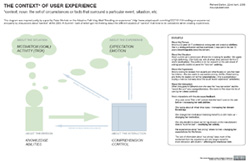
The Context of User Experience - thumbnailHi. My name is Richard, and I have a problem – i’m a serial diagramist (yes, yes, I know its not a real word). I just can’t help it – I read or talk about something and my brain just starts to draw a diagram of how the parts fit together!

Anyway – here is the latest, its been brewing for a few months since I read PeterMe’s post “Noodling on experience” and recent discussions about “context” at the 2008 IA Summit caused me to dig it out again and finish it.

Its a framework for the different aspects that make up the context of a user experience (8 aspects grouped into 4 groups). I think its useful – but I can’t quite put my finger on how, so I thought i’d throw it out there and see if it knocked anything loose.

Creative Commons LicenseThis work is licensed under a Creative Commons Attribution-Share Alike 3.0 License.